Which subscription model to choose for your business?
There are several subscription models. Their flexibility and customization possibilities make them attractive for any type of business. Which model should you adopt for your company?
The subscription market explosion
The subscription industry is experiencing exceptional growth: in the United States, subscription company revenues grew 5 times faster than those of the average S&P 500 company between 2013 and 2019.
Many companies are turning to the subscription model to stabilize their revenues and modernize their business model. Indeed, the subscription industry has been exploding for several years.
This growth is explained by several key factors:
- Financial stability: recurring and predictable revenues
- Customer loyalty: lasting and personalized relationship
- Flexibility: adaptation to the specific needs of each sector
Despite this exceptional growth, the subscription industry has not yet reached its peak. Industry specialists predict an explosion of the subscription model in the coming years.
Expansion into new sectors
If initially this model was reserved for software and digital services, it is gradually expanding to other sectors, B2B and B2C, particularly in retail.
Many traditional companies have already made the leap:
- Gillette: automatic replenishment of razor blades
- Walmart: retail subscription services
- Decathlon: rental and subscription for sports equipment
Impact of the health crisis
The health crisis related to Covid did not slow down companies' attraction to this model, quite the contrary. At a time when companies are massively digitizing their activities and seeking increased customer loyalty with predictable revenues, the subscription model emerges as an ideal choice.
The diversity of subscription models
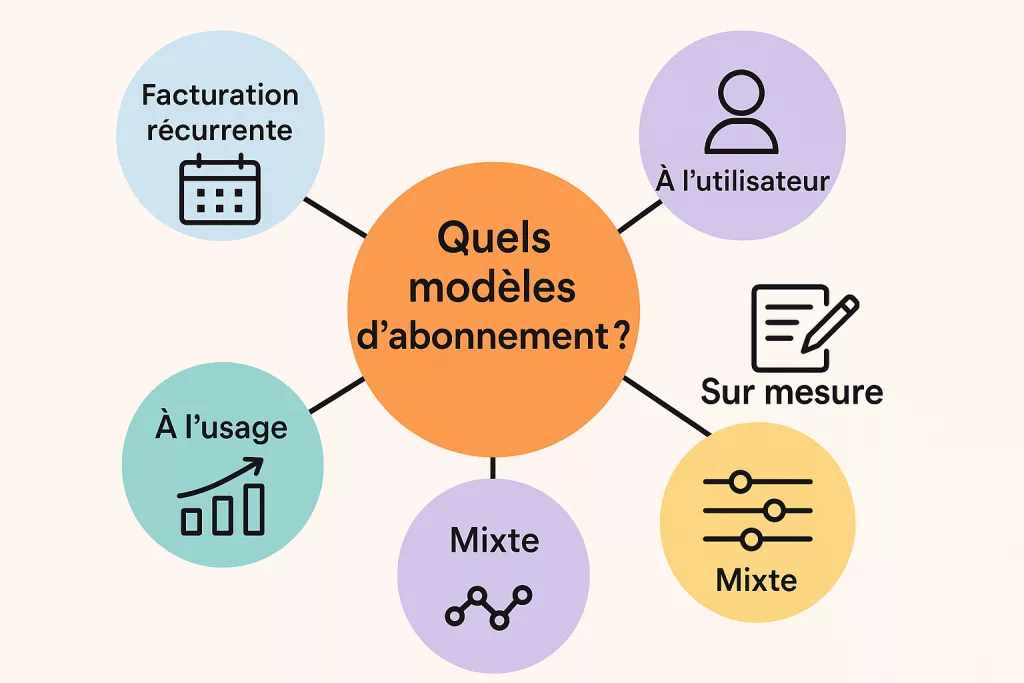
In reality, there is not one, but several subscription models. Their flexibility and customization possibilities make them attractive for any type of activity.
Which model should you adopt for your business?
Why launch an offering with a subscription model?
The viability of any subscription model relies on acquiring a certain number of paying customers and retaining them. The main objective: reduce churn.
How can adopting a subscription service sustain your business?
Recurring and predictable revenues
The main advantage of the subscription model lies in recurring and predictable revenues.
Recurring revenues allow you to:
- Forecast future cash flows
- Facilitate budget forecasting
- Optimize investments
To generate these revenues, companies must invest in customer acquisition. The total sales and marketing costs related to acquiring a customer corresponds to the Customer Acquisition Cost (CAC).
In the long term, the customer's lifetime value (CLTV) compensates for the CAC and contributes significantly to profitability.
Different lifecycle
The subscriber lifecycle is different from a traditional customer cycle: in a classic business model, revenues follow a linear path (marketing → sales → finance). In a subscription model, the revenue flow is cyclical and self-sustaining.
Increased customer loyalty
Furthermore, adopting a subscription model enables increased customer loyalty.
Customer motivations for subscription:
- Save time dedicated to recurring purchases
- Reduce costs through regularity
- Benefit from advanced personalization
Subscriptions are customizable and adapt to customer needs. They therefore allow for advanced personalization: the customer consumes only what they need.
This growth and flexibility journey contributes to:
- Strengthening customer loyalty
- Building a lasting relationship
- Increasing customer lifetime value (CLTV)
Effective demand forecasting
Finally, the subscription model enables effective demand forecasting. This is particularly the case for selling physical products by subscription.
Subscription allows for precise demand forecasting by analyzing:
- Subscriber purchasing habits
- Consumption cycles
- Seasonal preferences
Logistical advantages
This predictability facilitates efficient inventory management and enables significant savings on operational and logistics costs.
What subscription models are possible?
There are several types of subscriptions that adapt to both the product or service offered and customer consumption habits.
| Subscription Model | Principle | Advantages | Examples | |-------------------------|--------------|---------------||--------------| | Fixed recurring billing | Fixed price, billed recurringly | Simplicity, revenue predictability | Gillette, Spotify | | Per user | Billing based on number of users | Pricing clarity, scalability | Zendesk, Adobe Creative Suite | | Usage-based | Variable pricing based on consumption | Personalization, pricing fairness | Amazon Web Services, Fiat | | Hybrid | Variable price based on services included | Flexibility, sector adaptability | Gymlib, Hubspot | | Quote to cash | Fully customized | Maximum flexibility, bespoke pricing | Enki Connected Home |
Subscription based on fixed recurring billing
Subscription based on fixed recurring billing is an ideal solution for companies offering a product or service at a fixed price, billed recurringly.
It is perfectly suited to replenishment of daily products.
Key advantages:
- Most widespread model due to its implementation simplicity
- Easy integration into traditional business models
- High revenue predictability
- Simplified billing management
Concrete examples:
Per-user subscription
Per-user subscription bills the customer based on the number of users accessing the service.
This model is perfectly suited to offerings where pricing varies according to the number of users. Many SaaS companies have adopted it, notably Zendesk and Adobe Creative Suite.
Benefits:
- Excellent revenue predictability
- Great clarity for the customer
- Natural scalability with customer growth
Usage-based subscription?
Usage-based subscription relies on variable pricing. The company only bills what the customer actually uses.
Main characteristics:
- Fair and transparent pricing
- Advanced personalization according to needs
- Bespoke pricing adapted to each profile
This system favors advanced personalization and bespoke pricing. Amazon Web Services and Fiat are among the companies that successfully exploit this model.
Beware of complexity
This model requires more sophisticated measurement and billing systems than fixed-price models.
Hybrid subscription
Hybrid subscription is a flexible subscription model. It is chosen by companies that offer a subscription at a price that can vary depending on services included in the subscription.
Advanced features:
- Setup cost included in the subscription offering
- Possibility to add e-shop products to the existing offer
- Adaptation to all business sectors
Implementation examples:
The "Quote to cash" model
"Quote to cash" or fully customized subscription model allows for complete personalization of a subscription offering.
The Quote-to-cash process allows for complete personalization of a subscription offering.
Distinctive advantages:
- Maximum adaptation flexibility
- Compatibility with any product or service
- Fully personalized pricing
- Bespoke response to specific needs
Concrete use case: The connected home automation solution Enki Connected Home launched by Leroy Merlin perfectly illustrates this model.
* Nasdaq, June 2020.
Related Articles
DNVB and the Circular Economy?
Functional Economy: A Revolution for Rental
Discover the functional economy, a new model revolutionizing rental by prioritizing usage over ownership for sustainable consumption.
Turning Second-Hand Into a Profitable Business: The Guide
Second-hand is becoming a profitable business: lower sourcing costs, higher margins, stronger sustainability. A $350B market by 2028.