Appliance Refurbishment with Refit
Appliance refurbishment is a rapidly expanding sector gaining importance in our modern society.
Appliance refurbishment is a rapidly expanding sector gaining importance in our modern society.
Faced with rising environmental concerns and the need to reduce electronic waste, the refurbishment market positions itself as a viable and sustainable solution.
What is refurbishment?
The refurbishment process involves restoring used appliances to make them functional and sellable, thus offering an economic and ecological alternative to purchasing new products.
The growing importance of refurbishment is explained by several key factors:
- Environmental awareness: Consumers increasingly seek to reduce their ecological footprint by choosing refurbished products
- Business opportunities: Companies find in refurbishment an opportunity to generate additional revenue while contributing to environmental sustainability
- Growing demand: The demand for affordable and quality appliances continues to grow
Indeed, refurbishment helps meet this demand while limiting the production of new appliances.
Article objective
We will examine in depth the current state of the appliance refurbishment market. We will analyze statistics and trends, identify key market players, and discuss the advantages and challenges of refurbishment.
We will also address software solutions that facilitate this process, with a particular focus on Refit, an innovative platform in this field that we have developed.
The appliance refurbishment market
Market overview
The appliance refurbishment market is expanding rapidly.
With growing awareness of economic and environmental benefits, more and more consumers and companies are turning to this option.
Refurbished appliances are restored, tested, and certified to guarantee their functionality and safety, thus offering a reliable and affordable alternative to new products.
Statistics and trends
The growth of the appliance refurbishment market is impressive.
Key figures 2023
In 2023, the sector experienced a 15% increase compared to the previous year, and this trend is expected to continue in the coming years.
Consumers are increasingly turning to sustainable alternatives, thus favoring the growth of the refurbishment market.
Key figures reveal that more than 60% of appliances sold as refurbished come from customer returns and unsold items from large retailers.
This practice significantly reduces electronic waste while offering quality products at competitive prices.
Evolution of refurbished appliance types:
Current trends also show a diversification of refurbished appliance types.
Formerly mainly focused on small appliances like vacuum cleaners and coffee makers, the market now extends to major appliances such as refrigerators and washing machines.
This diversification responds to growing consumer demand for more ecological and economical solutions.
Role of digital platforms:
Finally, online platforms specialized in selling refurbished products play a crucial role in market growth.
They provide increased visibility to refurbished products and facilitate consumer access to these alternatives.
Main market players
The appliance refurbishment market is dominated by several large companies and innovative startups.
| Actor type | Examples | Specialties |
|---|---|---|
| Established leaders | Back Market, Recommerce | Sale of refurbished products, rigorous testing and certification processes |
| Innovative startups | Various tech startups | Technological solutions, disruptive approaches |
| Specialized SMEs | Local businesses | Flexibility, innovation, personalized approaches |
Among market leaders, we find companies like Back Market and Recommerce, which specialize in selling refurbished products.
These companies have successfully gained consumer confidence through rigorous product testing and certification processes.
The importance of startups:
Startups also play a crucial role in this sector.
The strategic role of SMEs:
The role of small and medium-sized enterprises (SMEs) should not be underestimated.
They represent a significant part of the refurbishment market and bring flexibility and innovation capacity that often rival those of large companies.
SMEs are often at the forefront of sustainable practices and personalized approaches, enabling them to meet specific consumer needs and quickly adapt to market changes.
The appliance refurbishment market is diversified and rapidly growing, with a combination of major players and innovative startups constantly pushing the boundaries of this dynamic sector.
Advantages of refurbishment
Economic advantages
Appliance refurbishment presents numerous economic advantages, both for consumers and businesses.
For consumers:
For consumers, the main economic advantage lies in reduced costs. Refurbished appliances are often sold at significantly lower prices than new products, allowing substantial savings.
This financial accessibility is particularly attractive for households looking to equip their homes without breaking the bank.
For businesses:
For businesses, refurbishment offers interesting economic opportunities. By reselling refurbished products, they can generate additional revenue while valorizing unsold stock or customer returns.
This not only reduces financial losses but also maximizes the use of available resources.
Impact on employment
Refurbishment also promotes job creation, particularly in repair, logistics, and sales. Companies specialized in refurbishment require skilled labor to test, repair, and certify appliances, contributing to stimulating the local economy.
Environmental advantages
Appliance refurbishment brings significant environmental benefits.
Reduction of electronic waste:
One of the main benefits is the reduction of electronic waste. By extending appliance lifespan, refurbishment helps decrease the volume of waste sent to landfills.
Appliances that would otherwise be thrown away are repaired and reused, reducing pressure on landfill sites and minimizing environmental impact.
Contribution to circular economy:
Refurbishment also contributes to the circular economy. Unlike the traditional linear economy, which relies on the "extract, produce, dispose" model, the circular economy aims to keep products and materials in circulation as long as possible.
Refurbishment plays a key role in this approach by reintroducing functional appliances to the market, limiting the need to produce new appliances and preserving natural resources.
Reduced carbon footprint
Moreover, the refurbishment process generally consumes less energy and raw materials than manufacturing new products. This translates to a reduced carbon footprint, thus contributing to the fight against climate change.
Advantages for consumers
Refurbishment also offers several direct advantages for consumers.
Accessibility and quality:
The accessibility of quality products at lower cost is one of the main attractions of refurbished appliances.
Consumers can acquire efficient and reliable appliances at prices significantly lower than new products, allowing substantial savings without sacrificing quality.
Warranties and services:
Furthermore, refurbished appliances often come with warranties and after-sales support services. Companies specialized in refurbishment test and certify appliances before putting them on sale, ensuring their proper functioning.
In case of problems, consumers can benefit from after-sales service similar to that offered for new products, strengthening their confidence in refurbished products.
Responsible approach
Finally, refurbishment allows consumers to adopt a more ecological and responsible approach. By choosing refurbished products, they contribute to reducing electronic waste and preserving natural resources, while supporting sustainable business practices.
Refurbishment challenges
Technical challenges
Appliance refurbishment presents several technical challenges.
Common technical problems:
Common technical problems include the difficulty of finding compatible spare parts and the complexity of certain repairs. Modern appliances increasingly integrate advanced technologies, making some technical interventions particularly complex.
Additionally, products from different brands may require specific skills and varied equipment to be properly refurbished.
Innovative solutions:
To overcome these challenges, refurbishment companies constantly innovate. They invest in training their technicians so they can handle a wide diversity of products and technologies.
The use of specialized software also facilitates fault diagnosis and helps find appropriate solutions more quickly. Partnerships with appliance manufacturers can also play a crucial role by ensuring regular supply of spare parts and technical information necessary for quality repairs.
Regulatory challenges
The refurbishment sector also faces regulatory challenges.
Complexity of standards:
Regulations and standards vary from country to country, and companies must ensure their products comply with all legal requirements in force.
This includes compliance with safety, energy efficiency, and environmental protection standards.
Impact of regulations
The impact of regulations on the refurbishment market can be significant. Companies often must invest time and resources to stay informed about legislative changes and adapt their processes accordingly.
Compliance with standards can also lead to additional costs, particularly for conformity testing and certifications.
Differentiation opportunity:
However, these challenges can also represent an opportunity for companies to differentiate themselves by guaranteeing the quality and safety of their products. By strictly complying with standards, they can gain consumer confidence and strengthen their reputation in the market.
Logistics challenges
Inventory and returns management constitutes another major challenge for refurbishment companies.
Supply chain complexity:
The logistics of transporting and storing refurbished appliances requires rigorous organization to avoid losses and damage. Appliances must be carefully inspected, repaired, tested, and finally stored under appropriate conditions before being put back on the market.
Returns management:
Product returns, whether from dissatisfied customers or partnerships with retailers, must be managed efficiently to minimize costs and maximize chances of restoring appliances to working condition. This requires high-performance tracking and inventory management systems to ensure each appliance is processed optimally.
Transport optimization
Logistics optimization also involves improving transport processes. Reducing transport costs while ensuring appliance safety is a constant challenge.
Companies can leverage technological advances, such as logistics management software, to improve operational efficiency and reduce delivery times.
Software solutions for refurbishment
Refurbishment management software plays a crucial role in optimizing refurbishment processes.
They enable automation and streamlining of various refurbishment stages, from product reception to their restoration and distribution. These tools offer better visibility and increased control over all operations, contributing to improving efficiency and profitability of refurbishment companies.
Main software on the market
Among available software, Refit particularly stands out for its ability to efficiently manage the entire refurbishment process.
Refit is designed to meet the specific needs of appliance refurbishment companies.
It offers an integrated platform that allows tracking products at each stage, from reception to restoration, through quality control and distribution, as well as highly advanced refurbishment scenarios.
Key features of refit
Refit offers several key features that facilitate refurbishment operations management.
Optimized inventory management:
Inventory management is optimized through precise tracking of spare parts and finished products. The software also allows tracking refurbished products, ensuring complete traceability from entry to product exit.
Advanced automation:
Process automation is another major advantage of Refit. The software allows automating repetitive and time-consuming tasks, freeing up time for technicians and improving overall efficiency.
Use cases
Several companies have already integrated Refit into their operations and derive significant benefits.
Concrete results
For example, a major appliance refurbishment company saw its processing times reduced by 30% thanks to process automation provided by Refit. Additionally, inventory management accuracy helped reduce costs related to inventory errors and material losses.
In summary, Refit establishes itself as an essential solution for appliance refurbishment companies, offering advanced features to optimize each process step and improve profitability.
Use cases
Several companies have already integrated Refit into their operations and derive significant benefits.
They have noticed a notable improvement in efficiency and reduction in processing times.
National deployment
Moreover, Refit is present in dozens of warehouses in France, testifying to its robustness and ability to meet the varied needs of companies of all sizes.
Refit establishes itself as an essential solution for appliance refurbishment companies, offering advanced features to optimize each process step and improve profitability.
Focus on Refit
Refit presentation
Refit is an innovative solution dedicated to appliance refurbishment.
Designed to meet the specific needs of refurbishment companies, Refit offers an integrated platform that simplifies and optimizes the entire process, from product reception to their restoration and distribution.
Services offered:
Refit services include:
- Inventory management
- Product tracking
- Task automation
This allows companies to gain efficiency and profitability. The platform is intuitive and easy to use, facilitating its adoption by technical and logistics teams.
Flexibility and adaptability:
Refit stands out for its ability to adapt to different types of appliances, thus offering a flexible and robust solution for companies of all sizes. The platform is already used by several recognized companies in the sector, confirming its effectiveness and reliability.
Refit features and advantages
Refit offers several key features that facilitate refurbishment chain management.
Advanced inventory management:
Inventory management is optimized through precise tracking of spare parts and finished products. Companies can thus control their inventory status in real time and anticipate supply needs.
Intelligent automation:
Process automation is another major advantage of Refit. The software allows automating repetitive and time-consuming tasks, such as:
- Product sorting
- Functionality testing
- Repair tracking
This frees up time for technicians, who can focus on higher value-added tasks.
Integrated quality control:
Refit also integrates quality control tools that ensure each refurbished product meets safety and performance standards before being put on the market.
Operational benefits
Process optimization through Refit translates into reduced operational costs and improved customer satisfaction. Companies can offer high-quality refurbished products while minimizing returns and complaints.
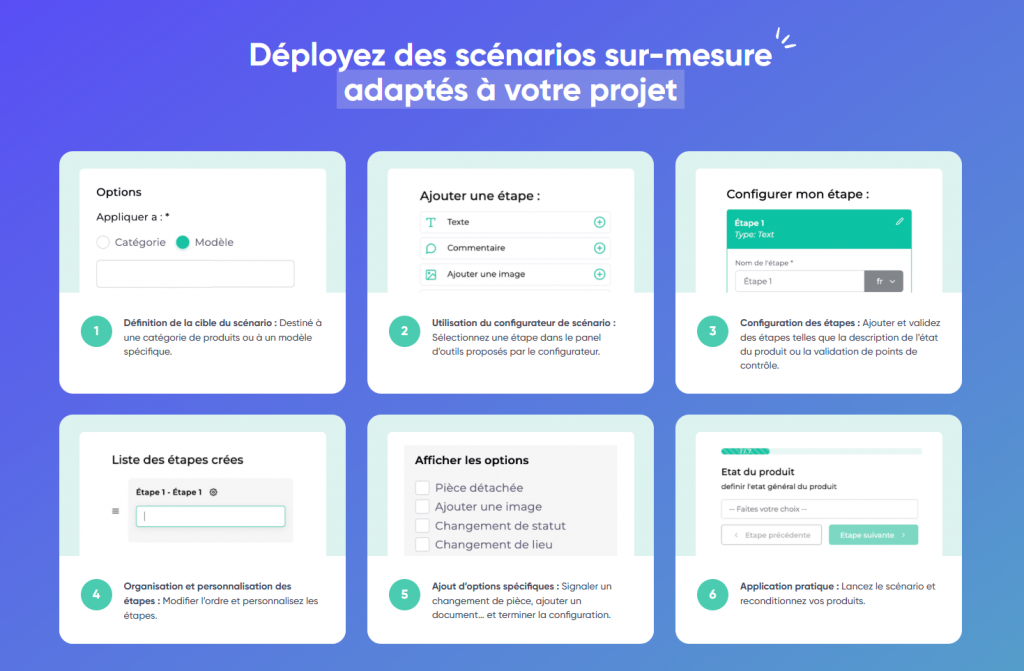
End-to-end personalized refurbishment scenarios are a strong point.
User feedback
Refit has received very positive reviews from its users.
Reference customers:
Companies like Decathlon and Reconomia have adopted Refit to manage their refurbishment operations and have validated its usefulness.
Measurable results:
Case studies show that companies using Refit have been able to increase their productivity while reducing operational costs.
Facilitated integration
Customers particularly appreciate Refit's ability to integrate with other existing management systems via API, thus facilitating the transition to a more automated and efficient solution.
How to use Refit for your business
Using Refit for your business is simple and intuitive.
The platform is designed to be easily integrated with your existing systems, thus minimizing disruptions during the transition.
To get started:
To start using Refit: you can directly go to this page to learn more.
Sources:
- Market Watch - Refurbishment 2023
- Statista - Growth of Refurbished Market
- Green Alliance - Circular Economy Report
- Consumer Reports - Refurbished Appliances
- Back Market - About Us
- Recommerce - Company Overview
- GreenWEEE - Innovation in Refurbishment
Related Articles
Back Market: $3.5B GMV in 2025, the Golden Age of Refurbished Tech
Back Market reaches $3.5B GMV in 2025: refurbished tech now grows 5 times faster than new products. Analysis of the pillars of this historic maturity.
European Refurbished Market: €30 Billion by 2033
New too expensive? ZIQY scales refurbished programs and targets a €30B market by 2033. Act now.

Nearshoring and refurbishment: 2025 logistics revolution
Supply chain too fragile? ZIQY links nearshoring + refurb to cut logistics costs by 15%. Take action now.